Our muscles do the tango
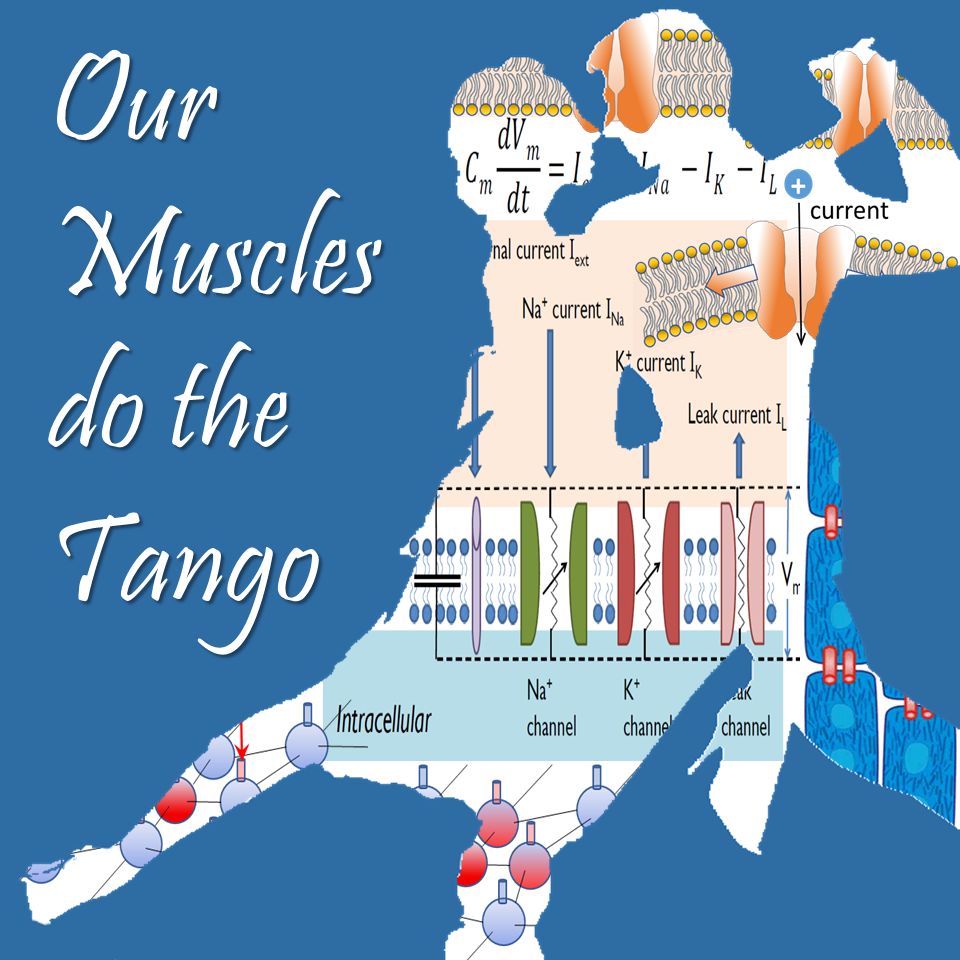
Caption
Imagine a crowded ballroom. The music is low, muffled by the chatter of a thousand guests. You are in the middle of the assembly, trying to dance in sync with the crowd, but you cannot hear the beat clearly. You are confused, stepping on toes, and moving slightly out of time with the person next to you. Suddenly, you feel a firm, rhythmic nudge from your neighbor. Not an instruction, but a physical push that sets you in sync. You adjust your stance, align your feet, and suddenly, the chaos vanishes. You are part of the wave of dancers around you.
This isn’t just a scene from a party. It is happening inside you right now.
Every time your heart beats, your digestive system moves food along, or the uterus prepares for childbirth, millions of cells must contract in a carefully coordinated rhythm to keep these organs functioning properly. For decades, scientists have believed that this coordination was driven entirely by electrical signals between nerve cells, the “music” of the body.
If the electrical wiring was cut, it was thought that the body would fall into disarray. But a recent study by researchers Soling Zimik and Sitabhra Sinha from The Institute of Mathematical Sciences, Chennai, has revealed that we were missing a crucial part of the performance. It turns out that when the electrical “music” fades, the body has a brilliant backup plan: it uses physical force to keep the beat.
To understand why this is a revolutionary finding, we have to look at how biological tissue works. Our organs are not made of identical units that are perfectly arranged, but are a complex messy neighbourhood, an assemblage of different types of cells having distinct behaviours. Some are “oscillatory”, meaning they are the natural drummers that keep a steady rhythm. Others are “excitable”, waiting for a signal to fire but otherwise sitting in the wings. For a long time, the prevailing wisdom in biology was that these cells communicate exclusively via electrical messages.When the “oscillatory” cells fire, the electrical signal travels through junctions linking neighbouring oscillatory cells in sequence, before finally reaching the excitable cells at the end of the relay, triggering their response.
But what happens when those electrical connections are weak? What happens when a piece of tissue is damaged by disease or age, and the electrical wiring is frayed? According to the traditional “electrical-only” view of biology, that part of the organ should lose coordination and become unresponsive to the signals. Yet, in many cases, our organs keep functioning. Zimik and Sinha asked the simple but obvious question: How?
Using a computational model that recreated a small patch of biological tissue as a lattice of interacting oscillatory and excitable cells, the authors explored what happens when electrical coupling becomes weak. They found that when electrical signals alone cannot keep the tissue in step, cells can fall back on a mechanical form of communication. As neighbouring cells contract and stretch one another, tiny channels in the cell membrane open, allowing ions to flow and thus restoring coordination through what are known as stretch-activated currents. This opening of the closed gates on the cell wall allows electrical currents to flow into the cell. Thus, it is a physical “nudge” that triggers the electrical signal which commands the cell to step in line with its neighbours.
The study found that these mechanical interactions allow for “global coherence” even when electrical signals are incapacitated. Going by our earlier analogy, this is like everyone dancing in sync to the music even when its “volume” is turned down low. By creating a mathematical model where they could adjust the strength of the electrical connections and the density of the rhythmic cells, they showed that mechanical coupling is able to overcome what they call the “source-sink mismatch”. In plain English, if one cell is falling out of step, the physical pull and push of its neighbours literally force it back into alignment. It is like the ballroom crowd physically grabbing each other to stay in rhythm, rather than just listening to the distant, muffled music.
This research does not just sit on a shelf; it changes how we think about human health and disease. One major area of impact is cardiac rhythm disorders. Such arrhythmias occur when the heart’s electrical system goes haywire. Doctors typically treat this with electrical interventions or medication to change how ions move through the cell membranes. However, in order to ensure that all the cells are reset, a large shock is required which damages the tissue and makes it heterogenous by creating scars. And very few pharmaceutical drugs that have been shown to be effective in treating cardiac arrhythmias.
The current study looks at this long-standing medical problem using a different lens altogether. According to the study, the heart is also relying on mechanical cues to synchronize, and by overlooking this key detail, our current treatments might be missing half the problem. If we can target the mechanical properties of the heart tissue, we might find new ways to stabilize irregular heart rhythms that have previously been extremely difficult to treat.
The same principles apply to the gastrointestinal tract. Conditions like irritable bowel syndrome often involve muscular contractions that are out of sync, leading to significant discomfort. By understanding how mechanical tension acts as a backup rhythm-setter, researchers can look toward therapies that address the physical stiffness or elasticity of the gut tissue rather than just trying to chemically influence the nerves. Furthermore, this research sheds light on the incredible coordination required during labour, where the uterus must transition from separate, uncoordinated contractions to an unified organ-wide contraction powerful enough for childbirth.
This discovery also invites a paradigm shift in how we approach diagnostic medicine. If a doctor could measure the mechanical properties of a patient’s tissue, essentially, how “stretchy” or “rigid” their cellular environment is, they could potentially predict who is at risk for rhythm disorders long before the symptoms appear. It opens the door to a future where we treat the physical architecture of the organs in as much detail as we consider its biochemistry.
Ultimately, Zimik and Sinha’s work serves as a humbling reminder that we are barely scratching the surface in unraveling the complexities of biology. We are not just a bag of reacting chemicals; we are physical, three-dimensional structures subject to mechanical forces of different kinds.
By viewing the body as a system where physics and biology are deeply intertwined, such a perspective may move us closer to solving some of the most persistent mysteries of human health and disease.
Next time you feel your heart racing or your stomach churning, take a moment to appreciate the silent, invisible dancers inside you.
Reference: Zimik, S., & Sinha, S. (2025). Mechanics Promotes Coherence in Heterogeneous Active Media. Physical Review Letters, 135, 248401. https://doi.org/10.1103/8gqg-rsrl